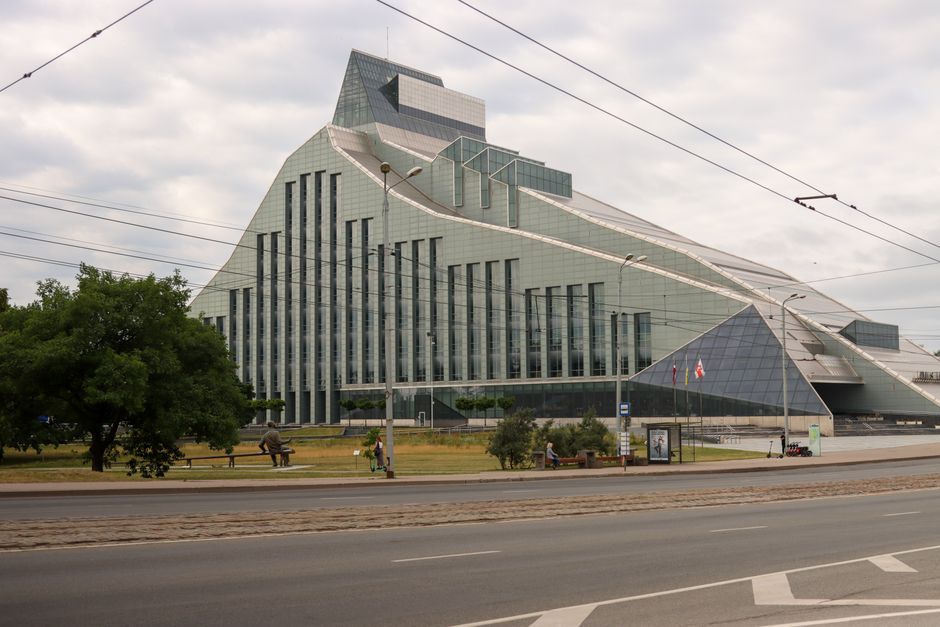
The National Library of Latvia stands on the far bank of the Daugava, at Mūkusalas iela 3, and it does not look like a bookshop, a campus block, or the Old Town. People call the building the Castle of Light. In Latvian that is Gaismas pils. Gunārs Birkerts designed it, construction ran from 2008 to 2014, and the building opened to visitors in 2014. Two faces are glass. The roof planes, which are also the north and south faces, are steel. From the Old Town side of the river it reads as a pale hill. From the entrance it reads as a public building with a long approach and a reason to look back at the spires you just left.
The form is not an accident of engineering. The library’s own account ties it to the poet Rainis and the story of a glass mountain, the Castle of Light that folklore and his writing put on the far side of the water. You do not need the poem to use the building. It helps to know the name is a local one, not a tourist nickname invented last summer. This website is not the library, and it cannot tell you what a desk will allow on the afternoon you happen to arrive.
What a visitor can reasonably expect
The building is a working national library and a piece of public architecture. Registered readers use the collections under the library’s rules. Visitors are a different category, and the library publishes that distinction because it matters. Some of the building is there to be walked through: the atrium, exhibitions, and the view from the upper public floors when those floors are open. Reading rooms are a further step, and they can require a card. Ask at the welcome desk on the day you arrive what a short-stay visitor may see, and whether you need any card at all.
Do not plan the hour as a bookshop with a novel you can carry out. The guide to English books in Riga is for buying. The library is for the national collections, and for the building. On a weekend, the honest aim is the architecture, the view, and whatever public room the desk opens. If you are here for months, ask how a reader card works. Bring identification. Leave the shopping bag at the hotel if you can.
Crossing the river
Give the library its own outing. It does not fold into a lap of the Old Town. Akmens tilts, the Stone Bridge, is the straightforward walk from the old centre toward this bank. Vanšu tilts, the cable-stayed bridge, sits further along the river and is the wrong shortcut if your pin says Mūkusalas iela. The notes on how to read a Riga address explain why “the bridge” is not an address.
Once you are across, the building is obvious, and the walk up to the doors is part of the visit. You see the steel and the glass as a whole, which you cannot do from the square by St Peter’s. On the way back, stop on the bridge and put the Old Town in order. The towers behind you, and the library in front, are the two shapes you will use later when a side street turns you around.
What to read there, and what to read after
If you get a desk, you are in a research library, not in a holiday reading room with this week’s paperbacks. Foreign-language books are part of the collection. A particular English novel may or may not be on the shelf, and a blog should not promise a call number. Bring the book you already own if your only certain plan is to sit. If you want a Latvian novel in English and you do not yet have one, choose it before you cross the river. The list in Latvian books to read in English is a starting five, available from shops and from publishers, not a catalogue of what the library will hand you in an hour.
When the building was new, people across Latvia passed books toward it by hand. You will not see every donated volume. For a visitor, the point is a national library that looks like a hill of glass and still behaves like a library: quiet where the reading is, and serious about who may handle the stock.
A shape for the visit
Go in the morning if you want the rooms calm, or later if you want the light on the glass and you have checked that the public floors are open. Look down the atrium before you look at your phone. Then decide, at the desk, whether today is a looking day or a reading day. Only one of them needs a card.
Afterwards, cross back. The cafés for reading are mostly on the Old Town side and in the centre: the monumental room first, an ordinary table second. Do not add Alberta iela to the same afternoon. If the desk turns you away from the reading rooms, you have still seen the building. The rules next time will be the ones posted then, not the ones remembered from a website.