A Riga address is easy to misread if you treat it as English with extra marks. The word that matters is usually the one after the name, not before it. Dzirnavu iela is a street. Aspazijas bulvāris is a boulevard. Rātslaukums is a square. Put the wrong label into a map, or drop the marks on the letters, and you can be a ten-minute walk from the door you wanted while the pin insists you have arrived. This is a reading guide for those words. It is not a list of opening hours, and it will not replace the sign on the corner.
The word after the name
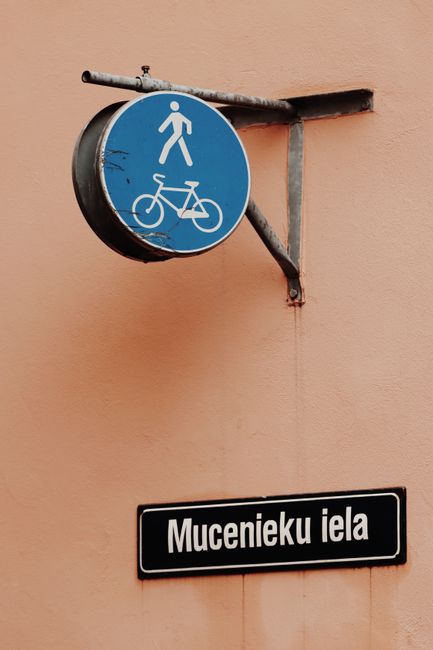
Latvian puts the proper name first and the kind of road second. You want Dzirnavu iela, not Iela Dzirnavu, and not a translated “Dzirnavu Street”. Copy what is written. The common words are few, and they change where you end up.
- Iela is a street. Dzirnavu iela, Vaļņu iela, Alberta iela, Baznīcas iela, and Mūkusalas iela are all this.
- Bulvāris is a boulevard, often beside a park. Aspazijas bulvāris runs by the Opera.
- Laukums is a square. Rātslaukums is Town Hall Square. The square and the street that leaves it are different meeting points.
- Prospekts is an avenue, uncommon in the Old Town. Gatve is a road out of town. Tilts is a bridge.
One route out of the centre changes its label as it goes. Around the Freedom Monument it is Brīvības bulvāris. Further out it becomes Brīvības iela, and further still Brīvības gatve. “Brīvības” alone is not a place. Ask which one.
Numbers, corners, and the ending on the word
The number follows the street: Dzirnavu iela 51, Baznīcas iela 30, Alberta iela 12. An apartment sometimes sits after it, with a dash or with dz. before the flat number. A building number is enough for a bookshop or a museum. Corner houses can carry two addresses, and the door you want may face the quieter street. Walk around the block once before you decide the place is shut.
Signs use the dictionary form: iela, bulvāris, laukums. Speech often adds another ending. “Dzirnavu ielā” is still Dzirnavu iela. Search for the form on the sign. If you cannot spell what someone said, ask them to write it.
The marks on the letters
The marks are not decoration. A macron lengthens a vowel. Č, š, and ž are not c, s, and z. Ģ, ķ, ļ, and ņ are not g, k, l, and n. Krišjāņa Barona iela is the bookshop street by the park. Drop the marks and a map may still cope, or it may offer you a shorter name that only looks similar.
Street names are often in the possessive. Dzirnavu means “of the mills”. You do not need the translation to find the courtyard bookshop, and translating it yourself can hide the name from the map. Keep the Latvian. The guide to where to find English books in Riga uses these full forms on purpose: Krišjāņa Barona iela 5, Vaļņu iela, Aspazijas bulvāris 24, Dzirnavu iela 51. Paste them. Do not shorten “Krišjāņa Barona” to “Barona” until you can see the park and know you are on the right stretch. Other streets also carry his name in shorter form, and the bookshop is at the long one.
Old Town, centre, and the other bank
The Old Town is a small knot, and a wrong turn inside it is only a few minutes unless you leave by the wrong gate and keep going. Town Hall Square, St Peter’s, and the Swedish Gate sit in that knot, which is what the Riga free walking tour notes describe. Alberta iela, on the Art Nouveau walk, is past the canal. Baznīcas iela, where the Rainis and Aspazija house stands, is centre rather than Old Town. Mūkusalas iela is on the far bank of the Daugava. Reading “iela” correctly will not tell you which side of the river you are on. Look at the water before you trust a phone’s ten-minute guess.
Bridges have names too. Akmens tilts, the Stone Bridge, is the direct walk from the Old Town side toward the library. Vanšu tilts is the cable-stayed bridge further along the river. They are not substitutes. If a direction says “cross the bridge” and does not name it, ask which one. Riga has several, and the wrong one is a long way round with a bag of books.
A way to check before you set out
An address has three parts: name, kind of road, number. If one is missing, you do not have it yet. “The bookshop in the centre” is a mood. “Valters un Rapa, Aspazijas bulvāris 24” is a door. Put the full line in your phone in Latvian, marks included, and check it on the corner. A pin can sit on the right building and still leave you at the back gate.
Learn those words and you can read most of what these guides ask you to find. The city will still offer a courtyard, a second entrance, or a street that changes its name at a monument. The mistake to avoid is the English one: dropping “iela”, translating the name, and walking the wrong way with confidence.